Home> Industry News> Urban Guardrails and Road Safety Barriers: Engineering, Design, and Selection Guide for Municipal Infrastructure Projects

Urban Guardrails and Road Safety Barriers: Engineering, Design, and Selection Guide for Municipal Infrastructure Projects

2026,08,21
Every year, road traffic accidents claim over 1.3 million lives globally, and tens of millions more suffer serious injuries. Guardrails, safety barriers, and pedestrian protection infrastructure are among the most cost-effective tools available for reducing the severity of traffic accidents when they occur, and for physically separating different categories of road users to prevent collisions in the first place.
 
Yet guardrail selection is too often treated as a purely commodity decision, driven by minimum specification compliance and lowest price rather than by a genuine engineering assessment of what is needed to protect people in specific road environments. This approach leads to underperforming infrastructure that fails when it is needed most.
 
This guide provides infrastructure engineers, municipal road safety officers, and project managers with a comprehensive framework for understanding, specifying, and procuring guardrail and road safety barrier products. We cover the full range of barrier types, from heavy structural crash barriers on high-speed roads to decorative pedestrian railings in city center environments, with particular attention to the engineering principles that should drive specification decisions.
 
TONCOM has been manufacturing road safety and pedestrian barrier products since 2009, with installations across more than 170 cities in China and internationally. Our product range covers the full spectrum from heavy highway crash barriers to decorative city center railings, and our engineering team has extensive experience in advising on the appropriate specification for different application contexts.
 
T-GLL-41
 
PART ONE: THE MECHANICS OF BARRIER PERFORMANCE
 
1.1 Why Guardrails Save Lives
Understanding how guardrails protect lives requires understanding the physics of vehicle collisions with barriers.
When a vehicle strikes a barrier, the barrier's job is to manage the kinetic energy of the collision in a controlled way that minimizes the deceleration forces acting on the vehicle occupants, redirects the vehicle away from the hazard that the barrier is protecting (whether a drop, opposing traffic, a bridge pier, or pedestrians), and contains the vehicle within the road corridor, preventing it from leaving the road.
The performance of a barrier in achieving these objectives depends on its stiffness, its capacity to absorb energy through controlled deformation, its working width (the lateral distance through which the system deflects during impact before it reaches its maximum deflection), and its length and continuity (a vehicle that strikes the end of a barrier, or that punches through a gap in a barrier run, receives none of the protection the barrier was intended to provide).
Modern barrier engineering has developed sophisticated systems that optimize the balance between these parameters for different road environments. A stiff barrier with minimal working width is appropriate where there is insufficient space for lateral deflection (for example, on a narrow bridge deck), while a more flexible system with larger working width is appropriate where space allows and lower deceleration forces are desirable.
 
1.2 Containment Level Classification
The international standard approach to classifying barrier performance is through containment level testing, in which full-scale vehicles at specified speeds and angles of impact are crashed into the barrier, and the results are assessed against defined performance criteria.
The European standard EN 1317 defines containment levels from N1 (normal containment, suitable for most standard road situations) through H4b (very high containment, suitable for roads used by very heavy vehicles or in particularly demanding situations). Each containment level is defined by a specific test vehicle type, speed, and impact angle.
When specifying a heavy duty steel road guardrail for urban expressway and highway median, engineers should identify the containment level required based on the road category, traffic composition (specifically the proportion of heavy goods vehicles), speed limit, and the severity of the consequences if a vehicle overrides or penetrates the barrier.
 
1.3 The Importance of System Continuity
A common specification error is to focus on the performance of the barrier element itself without adequately addressing end treatments and the transition zones where barriers of different types or different structural characteristics meet.
A vehicle that strikes the end of an inadequately protected barrier run can be caught by the end and experience severe deceleration, creating conditions that can be as dangerous as hitting the obstacle the barrier was intended to protect. Safety-approved end treatments are designed to accept vehicle impacts from the end of the barrier run in a controlled way that minimizes risk to occupants.
Transition zones between barriers of different stiffness, for example between a flexible wire rope barrier and a rigid concrete wall, must be engineered to prevent the more flexible barrier from effectively becoming a ramp over which vehicles can vault. These transitions require carefully designed intermediate structural elements.
 
 
T-GLL-35
 
 
PART TWO: BARRIER TYPES AND APPLICATIONS
 
2.1 W-Beam Steel Guardrails
The W-beam (or Armco-type) steel guardrail is the most widely used barrier type in the world, recognized by its characteristic double-wave profile and silver galvanized finish. Its widespread use reflects its combination of reasonable cost, proven performance across a wide range of conditions, ease of installation and repair, and good availability.
W-beam systems are appropriate for most standard rural and urban road situations where working width of 1 to 1.5 meters is acceptable. They are typically post-mounted on steel W-section posts at 1.33 or 2.0 meter centers, with the beam height adjusted to match the bumper height profile of the design vehicle.
The heavy duty steel road guardrail for urban expressway and highway median in heavy traffic applications may use thicker gauge W-beam (3 mm rather than the standard 2.5 mm), closer post spacings, and blocked-out (double-element) configurations that increase stiffness and containment performance.
 
2.2 Box Beam Steel Guardrails
Box beam guardrails use a rectangular hollow section beam rather than the profiled W-beam. This gives a cleaner aesthetic appearance that is often preferred in urban environments, while providing comparable or superior structural performance to standard W-beam systems.
TONCOM's box beam guardrail range is particularly popular for urban arterial roads and expressways where the visual quality of infrastructure is a consideration alongside performance. The flat surfaces of box beam profiles also simplify the integration of reflective elements, signage, and (where required) decorative treatments.
 
2.3 Concrete Safety Barriers
For the most demanding applications, precast or cast-in-place concrete safety barriers (often referred to by the proprietary name "Jersey barriers") provide very high containment performance with essentially zero maintenance requirements over their service life.
Concrete barriers are routinely used for highway central reservations carrying very heavy traffic volumes, bridge barriers where structural weight considerations allow the greater dead load, temporary traffic management where high containment is needed and the barrier may be subject to heavy use, and permanent roadside barriers protecting pedestrians and cyclists in high-risk urban locations.
The main disadvantages of concrete barriers are their high initial weight and installation cost, the difficulty and cost of relocation once installed, and their relatively unforgiving performance in low-speed impacts (which is more relevant in urban than highway applications).
 
2.4 Pedestrian Guardrails and Safety Railings
In urban environments, the protection of pedestrians from traffic is as important as the protection of vehicle occupants. The anti-collision traffic barrier for bus lane and protected bike lane infrastructure is a specific application addressing the growing need to provide physical separation between motorized traffic and vulnerable road users.
Pedestrian guardrails and safety railings serve three distinct functions:
Channeling and guidance: Directing pedestrians to crossing points, along designated footways, and through structured waiting areas at bus stops and transit stations.
Physical containment: Preventing pedestrians from stepping into traffic unexpectedly, particularly at high-risk locations such as schools, bus stops, level crossings, and locations with high vehicle speeds.
Traffic calming and lane separation: Providing physical delineation of bus lanes, protected bike lanes, and other segregated road space, making encroachment by other vehicles physically difficult.
 
2.5 Decorative Urban Railings
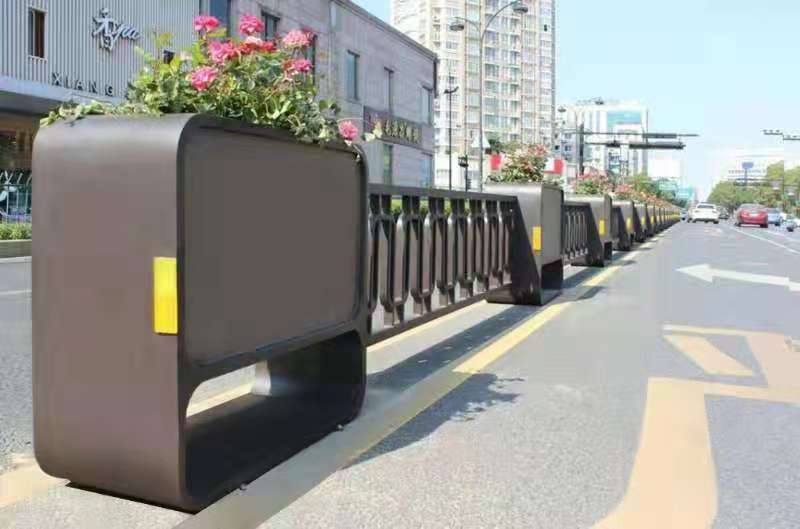
For city center pedestrian areas, parks, bridges, and heritage districts, purely functional barrier design is often inappropriate. The decorative pedestrian safety barrier for city center streetscape improvement must reconcile functional safety requirements with the aesthetic quality of the urban environment.
TONCOM's decorative railing range includes designs that draw on classical ornamental metalwork traditions for use in heritage and conservation areas, contemporary geometric designs suitable for modern urban environments, custom designs developed in collaboration with the client's urban designers and architects, and designs that incorporate functional elements such as Seating ledges, planters, and bicycle parking integrated into the barrier structure.
Material options for decorative railings include powder-coated mild steel, hot-dip galvanized steel with factory powder coat finish, stainless steel for premium locations and coastal environments, and weathering (Corten) steel for a distinctive natural aesthetic appropriate to some design contexts.
 
CONCLUSION
 
Road safety barriers and pedestrian protection infrastructure are among the most important life-saving investments that a city or road authority can make. The heavy duty steel road guardrail for urban expressway and highway median, the decorative pedestrian safety barrier for city center streetscape improvement, and the anti-collision traffic barrier for bus lane and protected bike lane infrastructure represent different application contexts, but all share the same fundamental purpose: protecting people.
TONCOM's comprehensive range of barrier products, combined with our engineering expertise and our experience across more than 170 cities, makes us a strong partner for road safety infrastructure projects of all scales. We invite engineers, procurement teams, and road authorities to contact our team to discuss specification, supply, and technical support for their guardrail and barrier projects.
 
Contact Us

Author:

Ms. Li

Phone/WhatsApp:

+86 15986817332

Popular Products
You may also like
Related Categories

Email to this supplier

Subject:
Mobile:
Email:
Message:

Your message must be between 20-8000 characters

Copyright © 2026 Ningbo Toncom Municipal Facility Technology Co., Ltd. All rights reserved. Privacy Policy

We will contact you immediately

Fill in more information so that we can get in touch with you faster

Privacy statement: Your privacy is very important to Us. Our company promises not to disclose your personal information to any external company with out your explicit permission.

Send