Home> Industry News> Intelligent Electronic Bus Stop Signs: How Smart Transit Display Technology Is Revolutionizing Public Transportation

Intelligent Electronic Bus Stop Signs: How Smart Transit Display Technology Is Revolutionizing Public Transportation

2026,09,06
The quality of information available to transit passengers is one of the most powerful determinants of their experience and, ultimately, of whether they choose to use public transit at all. For decades, research has consistently shown that the uncertainty of waiting, not knowing when the next bus will arrive, is a more significant deterrent to transit use than actual service frequency. Providing reliable, accurate, real-time arrival information transforms the passenger experience fundamentally.
 
Intelligent electronic bus stop signs are the hardware platform that delivers this transformative information to passengers at the point of use. Far more than simply a display device, a modern intelligent bus stop sign is a sophisticated IoT node in the urban transit network, combining real-time data processing, multiple communication protocols, solar or grid power management, environmental sensing, and increasingly, emergency broadcast and smart city integration capabilities.
 
This guide provides a comprehensive examination of intelligent electronic bus stop sign technology, for transit authorities, city planners, infrastructure procurement teams, and technology officers who are responsible for specifying, procuring, or managing passenger information systems. We examine the technology in depth, explore the different product categories and their appropriate applications, and provide practical guidance on specification, procurement, and operation.
 
TONCOM has been developing and manufacturing intelligent electronic transit display products since the mid-2010s. Our products are deployed across multiple cities in China and internationally, providing real-time transit information to millions of passengers daily. This guide reflects our accumulated technical and operational knowledge in this field.
 
 
THC-263THC-263
PART ONE: THE IMPORTANCE OF REAL-TIME PASSENGER INFORMATION
 
1.1 The Psychology of Waiting
Academic research on the psychology of waiting has produced remarkably consistent results: people significantly overestimate the duration of uncertain waits compared to waits of the same actual duration where the remaining wait time is known. This effect, known in service operations research as the "uncertain wait effect," is particularly pronounced at transit stops.
Providing accurate arrival information transforms uncertain waits into known waits, dramatically reducing the perceived stress and duration of the waiting experience. Passengers who know that the next bus will arrive in 6 minutes experience that wait very differently from those who know only that the bus runs every 15 to 20 minutes and may have passed recently.
The provision of real-time information also reduces risk behavior: passengers who do not know when the next bus will arrive are more likely to hail taxis, start walking, or abandon their transit trip altogether. Real-time information reduces these abandonment rates and contributes to higher transit ridership.
 
1.2 Operational Benefits
Beyond the direct benefit to passengers, real-time passenger information systems provide operational benefits to transit operators:
When passengers know the bus is 15 minutes away, they tend to arrive at the stop more predictably, reducing bunching at stops as passengers who arrive early realize there is time to stop briefly at a shop or use a nearby facility.
Real-time information systems are typically integrated with the transit authority's vehicle tracking systems, providing a feedback loop that supports operational management and incident response.
The data generated by passenger information systems provides valuable analytics for service planning, including passenger demand patterns by stop, time of day, and day of week.
 
1.3 Accessibility Benefits
For passengers with visual impairments, cognitive disabilities, or limited language skills, audio and multi-language information output from intelligent bus stop signs provides critical access to the transit system. The multi-language smart bus stop display with emergency broadcast capability is particularly valuable in cities with diverse linguistic communities or high tourist visitation.
 
PART TWO: TECHNOLOGY FUNDAMENTALS
 
2.1 Display Technology
The display panel is the most visible component of an intelligent bus stop sign, and its specification has a major impact on both information legibility and energy consumption.
LED matrix displays were the dominant technology through the 2000s and remain widely used because of their excellent brightness-to-energy-consumption ratio, very high reliability, and relatively low unit cost. LED matrix displays can be read in full sunlight and have service lives well above 100,000 hours. Their limitation is the relatively low information density achievable with a typical matrix configuration, though modern high-density LED arrays can present text, graphics, and even low-resolution images.
Full-color LCD panels offer much higher information density and the ability to display maps, route diagrams, advertising content, and complex graphics. However, they consume more energy than LED alternatives and may require supplementary heating in very cold climates to maintain performance.
E-ink or electronic paper displays offer very low energy consumption and excellent readability in sunlight, but cannot update rapidly and are limited to black-and-white or limited-color content. They are suitable for applications where near-static content (service information, timetable data) is displayed, but not for dynamic real-time arrival countdown applications.
TONCOM's intelligent electronic bus stop sign with real time arrival display for urban transit networks uses high-brightness LED matrix technology as the primary display, offering the best combination of legibility, reliability, and energy efficiency for this application.
 
2.2 Communication Systems
The communication infrastructure connecting bus stop signs to the central transit management system is a critical element of the overall system architecture. Several options are available:
Cellular connectivity (4G/5G): Provides wide-area coverage without requiring installation of dedicated communication infrastructure. Data costs are ongoing but manageable. Security must be addressed through appropriate VPN or encryption implementation.
LoRaWAN: A low-power wide area network technology offering good range and very low data consumption, suitable for systems where data requirements are modest and battery or solar power is used.
Fiber optic or copper data networks: Where the bus stop has a mains power connection, it may also have access to the city's fiber or copper data network. This provides high bandwidth and low latency, supporting more sophisticated applications.
WiFi: In locations where the bus stop is within range of existing WiFi infrastructure, WiFi connectivity is a cost-effective option.
Hybrid systems: Many deployments use a combination of communication technologies, with cellular as the primary method and WiFi or LPWAN as supplementary options in high-density urban cores.
 
 
thc-100THC-166
2.3 Power Systems
The power system for an intelligent bus stop sign must be appropriate to the installation context. Three main options are used:
 
Grid-connected: Where mains power is available at the bus stop location, grid connection provides the simplest and most reliable power supply with no battery management required.
 
Solar-powered with battery storage: The solar powered digital transit sign for rural and suburban bus routes uses a photovoltaic panel and battery storage system to operate completely off-grid. System design must account for the electrical load of all display, communication, and ancillary systems, the seasonal variation in solar energy availability, the desired autonomy period (the number of days of operation without solar charging), and the ambient temperature range affecting battery performance.
 
Hybrid grid/solar: In locations where grid power is available but solar is also practical, a hybrid system can reduce grid consumption while maintaining full reliability.
 
TONCOM's solar-powered bus stop sign products are engineered specifically for the combination of high-efficiency monocrystalline PV panels, lithium iron phosphate battery technology (which offers superior cycle life and thermal stability compared to standard lithium-ion), and intelligent power management that prioritizes display operation and allows other functions to be reduced in low-power conditions.
 
2.4 Connectivity to Transit Management Systems
The intelligent bus stop sign does not generate real-time arrival data itself; it displays data received from the transit management system. The integration between the sign and the central system is therefore critical.
Integration typically uses GTFS-RT (General Transit Feed Specification, Real-Time), an open-standard format for real-time transit data that is widely supported by transit authorities and technology providers. Systems using GTFS-RT can be updated by any compliant transit data source, providing flexibility for future changes in transit technology platforms.
Proprietary API integrations are also used in some deployments, particularly where the transit authority's system predates the adoption of open standards. TONCOM's systems can be configured to interface with both GTFS-RT and a wide range of proprietary API formats.
 
PART THREE: PRODUCT CATEGORIES AND APPLICATIONS
 
3.1 Standard City Center Signs
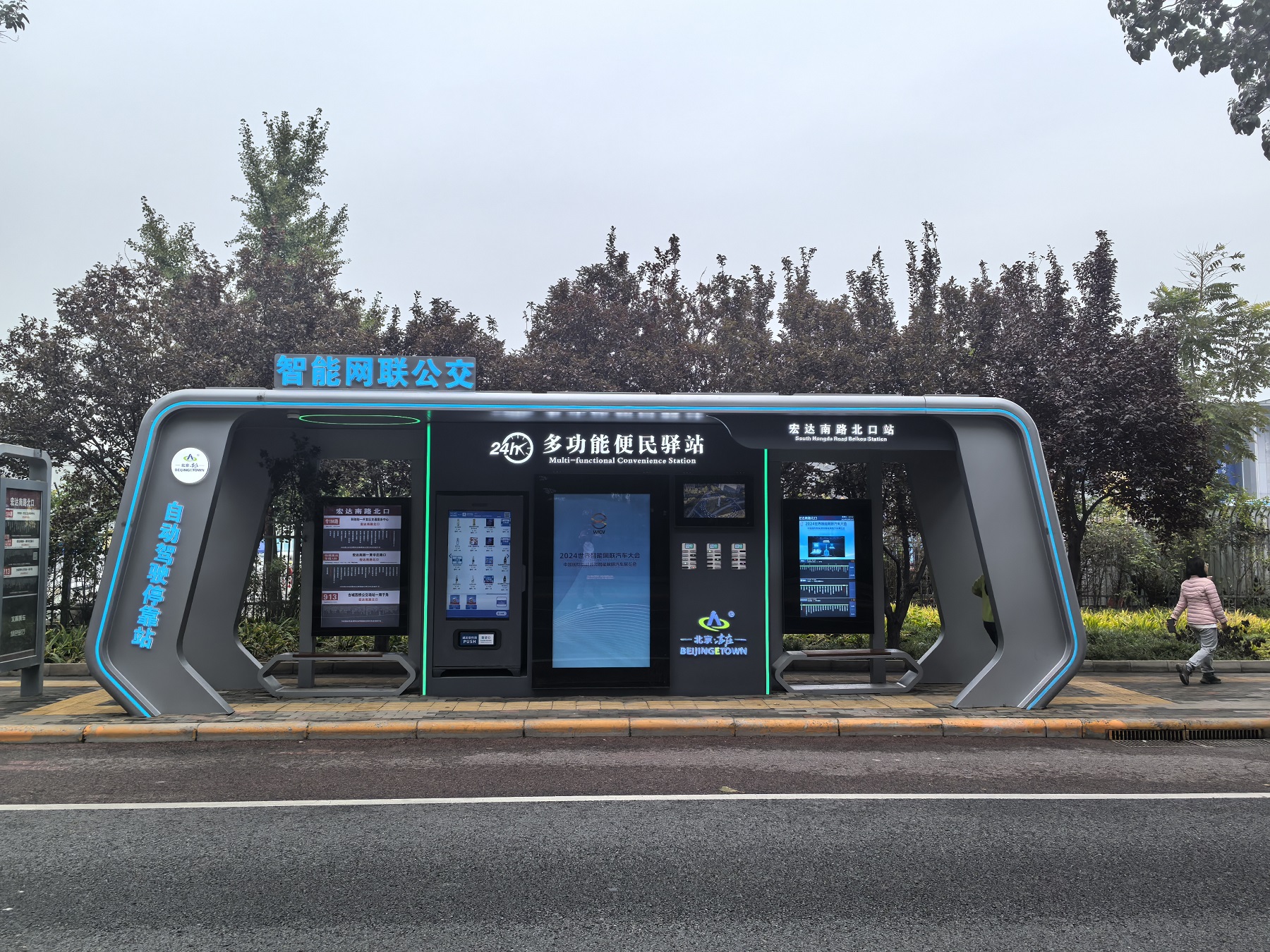
For urban transit networks in city centers and dense urban areas, standard intelligent electronic bus stop signs typically feature full-color LED displays showing next 2 to 3 vehicle arrivals per route, time-to-arrival in minutes, route number and destination, and current time.
Additional information displays may include service disruption and diversion alerts, accessibility information (low-floor vehicle indicator), weather information, and advertising content where an advertising revenue model is used.
Power supply for city center stops is typically grid-connected, simplifying system design and reducing maintenance complexity.
 
3.2 Rural and Suburban Solar Signs
The solar powered digital transit sign for rural and suburban bus routes serves a different requirement profile. Rural and suburban stops typically have lower passenger volumes and more irregular spacing, making grid connection economically unviable for many locations. Solar power is the practical solution.
Rural and suburban signs must be robust and low-maintenance because service visits are less frequent and more expensive than in city centers. System reliability must be achieved through quality component selection and careful engineering rather than through the ability to quickly dispatch a technician.
Content requirements for rural stops may be simpler than for city center locations, reflecting the typically simpler service pattern of rural routes. However, the information need may actually be greater, because rural passengers may have made a specific journey to catch a particular bus and have no alternative transport if they miss it.
 
CONCLUSION
 
The intelligent electronic bus stop sign with real time arrival display for urban transit networks, the solar powered digital transit sign for rural and suburban bus routes, and the multi-language smart bus stop display with emergency broadcast capability are not simply display devices. They are sophisticated IoT nodes that transform the passenger experience of public transit while providing transit operators with valuable operational data and extending the utility of transit infrastructure as a platform for smart city services.
 
TONCOM's intelligent transit display products represent the current state of the art in this technology, combining proven hardware reliability with sophisticated software integration capabilities and the solar power engineering needed for cost-effective deployment across all types of transit networks.
We invite transit authorities, city planners, and smart city technology teams to discuss how TONCOM's intelligent transit display solutions can enhance the passenger experience and operational effectiveness of their transit networks.
Contact Us

Author:

Ms. Li

Phone/WhatsApp:

+86 15986817332

Popular Products
You may also like
Related Categories

Email to this supplier

Subject:
Mobile:
Email:
Message:

Your message must be between 20-8000 characters

Copyright © 2026 Ningbo Toncom Municipal Facility Technology Co., Ltd. All rights reserved. Privacy Policy

We will contact you immediately

Fill in more information so that we can get in touch with you faster

Privacy statement: Your privacy is very important to Us. Our company promises not to disclose your personal information to any external company with out your explicit permission.

Send